

The True Cost of HVAC Marketing in South Florida (2027 Budget)
October is when most HVAC owners in South Florida start sketching next year's budget. Before you sign another contract or renew a software plan, it helps to see what each marketing option actually costs once the add-ons, implementation fees, and contract minimums are counted, and who ends up owning your lead data when the year is over.
Disclosure: this list is written by VelozLab, and we are one of the options compared. We kept the descriptions of every option factual and told you when someone else is the better fit.
Key takeaways
- Software platforms like ServiceTitan can cost $245 to $500 per technician monthly plus thousands in setup fees before you add tracking.
- Google Local Services Ads deliver the lowest cost per lead for HVAC, but you still need someone managing the account and the follow up.
- The cheapest option up front is rarely the cheapest option after twelve months of hidden fees, missed leads, and licensing risk.
The criteria that actually matter
Before ranking anything, here is what we judged each option on. These are the same questions you should ask any vendor before you sign.
- Results focus: does the option drive booked jobs, not just clicks or impressions.
- Local knowledge: does it understand South Florida's weather, codes, and buying patterns from Stuart to Miami.
- Owning your data: do you keep your lead history, call recordings, and ad data if you ever leave.
- Consistency: can it run month after month without stalling every time someone gets busy.
- Total cost: the real monthly number after setup fees, add-ons, and contract minimums.
- Support: who answers the phone when a campaign breaks or a lead gets missed.
Option 1: Doing it yourself with Google and free tools
Some HVAC owners run their own Google Local Services Ads account, post on social media between jobs, and answer leads from their truck. This can work if you have very few trucks and a lot of personal time. Local Services Ads for HVAC averaged $51 per lead in February 2026, with a 44 percent book rate and a 9.55x return on ad spend, the best performance of any trade tracked in that data set.
The limitation is time, not strategy. Most owners cannot run ads, write content, answer every review, and still install systems every day. Consistency breaks the moment a busy week hits, and marketing is consistency. DIY also carries real licensing risk. Florida requires anyone who bids, signs contracts, pulls permits, or advertises HVAC services to hold a state-certified or state-registered license through the DBPR, along with minimum liability coverage. Ads or offers that misrepresent licensing or pricing can create the same kind of problem we covered for electrical contractors running cheap marketing.
Best for
Single-truck operators testing the market before they can afford help.
Option 2: A freelancer from Upwork or Fiverr
Freelance digital marketers on platforms like Upwork charge a median hourly rate of around $25, with most falling between $15 and $45 an hour as of 2026. This is a low-cost way to get someone to write a few posts or set up a basic campaign.
The limitation is depth. A freelancer juggling several clients rarely has the bandwidth to manage ads, content, tracking, and reviews together, and most work month to month with no shared strategy. You also tend to own less of your own data, since logins, creative files, and reporting often live in the freelancer's personal accounts rather than yours.
Best for
Small, specific tasks like writing one landing page, not a full marketing system.
Option 3: HVAC software platforms with built-in marketing
Platforms like ServiceTitan and Housecall Pro are field service management tools that also offer marketing features. They are not marketing agencies, but many HVAC owners use them as their main source of lead tracking.
ServiceTitan
ServiceTitan does not publish pricing publicly. Third-party reports put the cost at $245 to $500 per technician per month across its Starter, Essentials, and The Works tiers, plus $5,000 to over $50,000 in one-time implementation fees and a standard twelve-month contract. If you want the add-on that actually ties ad spend to booked revenue by channel, that is Marketing Pro, an extra $500 to $1,500 per month on top of the base plan, not included by default.
Housecall Pro
Housecall Pro is more transparent. Its 2026 pricing runs three published tiers billed annually: Basic at $59 a month for one user, Essentials at $149 a month for up to five users with marketing tools included, and MAX at $299 a month for up to eight users with advanced reporting. Extra users cost $35 a month each.
Both platforms are strong for scheduling and dispatch. Neither replaces a strategist who decides what to say, where to spend, and how to track the full customer path. That is the exact gap we walk through in our guide to tracking which calls actually came from Google.
Best for
Companies that already have a marketing plan and just need better dispatch and billing software.
Option 4: National HVAC marketing agencies
Agencies that serve HVAC companies nationwide, such as RYNO Strategic Solutions, which merged with Blue Corona effective October 1, 2024, offer packages covering SEO, paid ads, and websites. Monthly retainers for this kind of agency typically run $1,500 to over $20,000, with SEO audits starting around $2,500. More broadly, national HVAC agencies charge between $3,000 and $25,000 a month depending on the service mix.
These agencies can be a good fit for larger multi-location companies with an in-house marketing contact who can manage the relationship. The tradeoff is local knowledge. A national team serving hundreds of HVAC clients across the country is not going to know South Florida permitting quirks, hurricane-season demand swings, or which neighborhoods in Stuart versus Miami respond to which offer.
Best for
Large, multi-market HVAC companies with their own marketing staff and budget to match.
Option 5: VelozLab, a local South Florida team
VelozLab handles local visibility, brand and content, paid ads, conversion, automation, and tracking under one roof for HVAC companies from Stuart to Miami. On the criteria above, here is where that matters most.
- Results focus: campaigns are built around booked jobs and ticket value, using the same channels, like Local Services Ads and traditional search, that the data shows actually convert for HVAC.
- Local knowledge: strategy accounts for South Florida's season, codes, and buyer behavior rather than a generic national template.
- Owning your data: you keep access to your ad accounts, call tracking, and content instead of a freelancer's personal login.
- Consistency: strategy is the foundation, so content and ads keep running through busy weeks and slow ones, because paid traffic alone does not build loyalty.
- Total cost: one predictable retainer instead of a software fee, an add-on fee, and a separate freelancer invoice stacked on top of each other.
- Support: one local team to call when something breaks, instead of routing between a software help desk and a freelancer's inbox.
For owners who want strategy, content, ads, and tracking managed as one system instead of three separate vendors, you can see how that works for HVAC specifically at VelozLab's HVAC marketing page.
Best for
Owners who want a single local partner accountable for the whole marketing system, not just one piece of it.
Where the budget should land
As a sanity check, most home-services businesses are advised to spend roughly 5 to 10 percent of revenue on marketing, meaning a $1 million HVAC company should plan for $50,000 to $100,000 a year. Whatever option you choose, run the math against that range before you sign anything for 2027. For a deeper look at how these options compare on service quality rather than just cost, see our earlier ranking of HVAC marketing options in South Florida.
Low price does not buy correct marketing, and the cheapest quote this month is often the most expensive one by next October. Pick the option that fits your size today, but budget with the real numbers, not the advertised ones.
Want more real numbers before you budget 2027?
Follow @velozlabagency on Instagram for weekly, practical marketing tips built for South Florida contractors and home service owners.


Cheap Marketing for Electricians Can Get You Fined, Not Hired
Low price does not buy correct marketing, and for electrical contractors this is not a slogan, it is a legal and platform reality. A cheap quote can leave you running ads that violate state law, disqualify you from Google's best local program, and still cost you more per lead than doing it right. This piece is about why the cheapest option in a regulated trade is often the most expensive one you will ever buy.
Key takeaways
- Florida law requires your contractor registration or certification number on every ad, bid, and proposal, and skipping it can trigger fines up to 10,000 dollars.
- Google treats electricians as high risk and will disqualify your whole business from Local Services Ads over one failed background check, no refund for the cheap setup that caused it.
- Electrician leads cost more than any other home services trade on Google, so a discount agency that ignores the compliant, lower cost channel is not saving you money, it is burning it.
The quote that skips the license number is not a bargain
Under Florida Statute 489.119, every offer of services, proposal, bid, contract, and advertisement you run, in any medium, must show your contractor registration or certification number. That means your Google Business Profile, your website footer, your Facebook ad, your truck wrap, and your printed flyer all need it. The licensing board can issue a notice of noncompliance first, then move to fines or citations if nothing changes.
This is not a minor paperwork detail. Florida's Electrical Contractors' Licensing Board oversees roughly 18,000 licensees under Chapter 489, Part II, and the state actively audits advertising for compliance. A marketing vendor who builds your ad campaigns, your website, or your Google listing without checking this requirement is not giving you a discount. They are handing you a liability with your name on it.
The fines are real and they stack
Florida does not treat advertising violations as a slap on the wrist. If you are found engaging in or advertising unlicensed contracting work, the Department of Business and Professional Regulation can impose an administrative fine of up to 10,000 dollars, plus investigative and legal costs on top of that. Even short of that, DBPR can issue a citation with a fine of up to 2,500 dollars simply for offering or advertising unlicensed activity, separate from any criminal exposure.
A cheap marketing shop that builds generic ad templates across trades, without understanding the specific disclosure rules for electrical contracting, is not saving you money on the front end. They are setting you up to pay the state later, on top of what you already paid them. We wrote about this exact trap in why a cheap marketing quote costs more later, and electrical contracting is one of the clearest proofs of that pattern.
Google does not grade on a curve for electricians
Even if your paperwork is clean, the platform itself can shut you out. Google's Local Services Ads program runs background checks on the business, the owner, and every field worker, and verifies licenses against state databases. Electricians are flagged as a high risk category facing Advanced Verification, which can include a video interview before you are approved to run a single ad.
Here is the part most owners do not know until it happens to them. One failed background check, for the business or for a single technician, disqualifies the entire business from the program. A denial means a 30 day wait to reapply, and a second denial triggers a 180 day lockout. If a low cost vendor rushes your setup, skips proper documentation, or does not prepare your team for verification, you are not looking at a slow month. You are looking at six months without access to one of the strongest local channels available to a contractor.
The real price of a lead when you cut corners
Electrical work is already the most expensive trade to advertise on Google. In 2026, electricians face an average cost per click of 12.18 dollars, higher than HVAC at 9.50, plumbing at 11.81, and roofing at 7.85. That gap compounds fast once you look at full lead cost.
- Traditional Google Search Ads cost electricians an average of 93.69 dollars per lead in 2026, the highest of any home services trade.
- Local Services Ads, the program with strict verification, deliver electrician leads at roughly 39 dollars each, about a 58 percent reduction.
- Median monthly lead costs have climbed from about 117 dollars in 2024 to 161 dollars through mid 2026, with monthly medians ranging from 124 to 190 dollars.
Put that together and the math is simple. A vendor who cannot get you qualified for Local Services Ads, because they rushed the compliance work, is quietly pushing you toward the channel that costs more than double per lead. The cheap setup fee you paid up front shows up later as a much higher cost per job booked. If you are not tracking which channel actually produces the call, you will never see this gap. That is exactly why we built out the reasoning in why contractors need to track every lead back to its source.
Why the budget was probably too small to begin with
Part of why owners reach for the cheapest quote is that most small businesses are already underfunding marketing. The Small Business Administration has long recommended that companies under 5 million dollars in revenue spend 7 to 8 percent of revenue on marketing. Yet The CMO Survey's January 2026 data found small businesses actually spend a median of just 5 percent. You are already starting from a smaller pool than the guidance recommends, so stretching it further with a bargain vendor only shrinks your margin for error on compliance and platform risk.
The honest counterargument
The strongest pushback is real and worth naming directly. Many electrical contractors are running tight margins, dealing with slow payment cycles, and a 2,000 dollar monthly marketing bill feels like a risk they cannot absorb compared to a 500 dollar option. That concern is legitimate, not naive.
But the comparison is not between a 500 dollar vendor and a 2,000 dollar vendor doing the same job cheaper or pricier. It is between a vendor who understands 489.119 disclosure rules, prepares you for Local Services Ads verification, and tracks your leads by source, versus one who does not. The first protects you from a 2,500 to 10,000 dollar fine and gets you into the 39 dollar lead channel. The second leaves you exposed to both the fine and the 93.69 dollar lead channel. The price difference between the two vendors is often smaller than the cost of the mistakes the cheap one makes.
What to check before you sign anything
- Ask directly if your license or registration number will appear on every ad, listing, and proposal they build.
- Ask if they have gotten other electrical or home services clients approved for Local Services Ads, and how they handle the background check process.
- Ask how leads are tracked back to the exact channel and campaign that produced them, not just a monthly total.
- Ask what happens if an ad account gets flagged or disqualified, and who is responsible for fixing it.
If a vendor cannot answer these clearly, the low price is not a discount. It is a deferred cost with your name on the fine.
Make sure your ads are compliant and your leads are cheap, not just your quote
Call VelozLab for a quick conversation about where your electrical contracting marketing stands on compliance, Local Services Ads eligibility, and real cost per lead.

The Best HVAC Marketing Options in South Florida (2026)
It is October 9, a Friday, and South Florida HVAC owners from Stuart to Miami are coming off the brutal AC replacement rush and into the slower fall stretch. This is the exact window when smart owners lock in next year's marketing budget instead of waiting until January. If you are comparing how to actually generate calls and installs for 2027, you have more real options than ever, and the price tags on each one differ more than most owners expect.
Disclosure: this list is written by VelozLab, and we are one of the options compared. We kept the descriptions of every option factual and told you when someone else is the better fit.
Key takeaways
- Cost per lead swings widely by channel, from around $51 on Google Local Services Ads to about $104 on standard Google Ads, so the vendor managing your spend matters as much as the spend itself.
- Most HVAC companies should plan to invest roughly 5 to 10 percent of revenue in marketing each year, which changes which options even make financial sense.
- Software, freelancers, and big national firms each solve one piece of the puzzle. A single local team that owns strategy, content, ads, tracking, and AI together is what keeps cost per lead low and consistent.
The criteria that actually matter
Before ranking anything, here is what you should judge every option against:
- Results focus: booked jobs and revenue, not just impressions or likes.
- Local knowledge: understanding of South Florida demand swings, permitting, and seasonality.
- Owning your data: your call tracking, reviews, and customer list stay yours.
- Consistency: the same team and strategy month over month, not constant turnover.
- Total cost: not just the monthly fee, but true cost per lead and per booked job.
- Support: someone who answers when a campaign breaks or a lead goes cold.
Option 1: Doing it yourself
This means the owner or office manager handles the Google Business Profile, basic Google Ads, and social posts using free or low cost tools. It is the lowest cost option on paper and works for a brand new company with almost no budget. The limitation is time and consistency. Without someone tracking which channel actually produced a booked job, most DIY efforts drift into posting when there is time rather than running a real plan.
Option 2: Freelancers on platforms like Upwork
Freelance digital marketers on Upwork charge a median hourly rate of $25, typically ranging from $15 to $45 depending on experience, with Upwork adding a 5 percent client fee and a 10 percent freelancer fee on top. This is a reasonable way to get a single task done, like building a landing page or writing a batch of posts. It is not a strategy. Freelancers rarely stay long term, rarely know HVAC demand patterns in South Florida, and nobody is accountable for whether the work actually produces leads. We cover this trap in more depth in Why a Cheap Marketing Quote Costs More Later.
Option 3: Software platforms like Podium and ServiceTitan Marketing Pro
Podium, used by many HVAC companies for messaging and review automation, prices its Core plan around $399 per month and Pro around $599 per month per location, both on annual contracts, with extra fees for added phone numbers. ServiceTitan does not publish pricing, but most contractors report paying $250 to $500 per technician per month for the base platform, plus $500 to $2,000 or more for the Marketing Pro add-on. These are real, useful tools for a company that already has strategy and campaigns running. They are not a replacement for one. Software automates tasks, it does not decide what to say, who to target, or how to track which call actually came from Google, which we cover in Which Calls Came From Google.
Option 4: National home services marketing specialists
Firms like Scorpion, which is ServiceTitan's sole preferred digital marketing partner for HVACR contractors and has worked in home services for more than two decades, typically require a 12 month contract for their marketing technology and SEO services. Industry analysis places firms in this category, including Blue Corona, as the right fit for multi-location HVAC companies over 10 million dollars in revenue, with monthly retainers running $5,000 to $25,000. This is the right option if you are running several locations with a real corporate marketing budget. It is oversized and overpriced for a single-location South Florida HVAC company.
Option 5: Mid-tier national HVAC agencies
Agencies that focus specifically on HVAC but serve contractors nationwide typically price entry level packages around $2,000 to $3,000 per month, scaling past $10,000 for fuller scope. These agencies know the HVAC business model, which is an advantage over generic marketing shops. The tradeoff is usually a remote account manager working from a national playbook, with limited understanding of South Florida specifics like snowbird demand spikes or hurricane prep timing that shift when homeowners buy.
Option 6: Local South Florida agencies
Some agencies are headquartered right in the region and build programs around specific counties. Blue Interactive Agency, based in Fort Lauderdale, is one example, focusing on local SEO and Google Maps visibility for Broward and Palm Beach County service areas. This is a strong fit if local search and maps ranking is your main gap. The limitation is scope. Many local agencies specialize narrowly in SEO or paid ads and do not also own your brand, content, tracking, and AI visibility under one roof.
Option 7: VelozLab, one local team
Most HVAC businesses should be investing 5 to 10 percent of revenue in marketing each year, which for a $1 million company means $50,000 to $100,000 across every channel. Where that money goes matters more than how much you spend. Google Local Services Ads produced an average cost per lead of $51 for HVAC contractors with a 44 percent booking rate, while standard Google search ads averaged $104 per lead. Getting that mix right, and proving it with real tracking, is a strategy decision, not a software feature.
This is where VelozLab ranks first for South Florida HVAC owners. We handle strategy, content, paid ads, tracking, and AI visibility as one local team, not five separate vendors billing separately. Against the criteria above, this means your results focus is tied to a single accountable team, your local knowledge comes from working in Stuart through Miami every day, you own your tracking and customer data, your marketing stays consistent instead of resetting every time a freelancer leaves, and your total cost is one invoice measured against real cost per booked job, not a stack of software subscriptions plus a freelancer plus an agency retainer. You can see how we approach this specifically for the trade at our HVAC marketing page.
We will say plainly where VelozLab is not the right fit. If you are a brand new company with almost no budget, start with the free tools and build your reviews before paying anyone. If you operate ten or more locations with a corporate marketing department, a national specialist built for that scale, like Scorpion, makes more sense than a local agency. VelozLab is built for the single-location to multi-truck HVAC company in South Florida that wants one team handling the whole picture instead of managing five vendors themselves.
Which option fits your business right now
If you are brand new and budget is near zero, start with doing it yourself and get your Google Business Profile and reviews in order first. If you need one task done well, a freelancer can work, but do not expect a strategy from an hourly hire. If you already have a strategy and just need better review automation, a platform like Podium or ServiceTitan Marketing Pro can help. If you run a multi-location chain with serious revenue, a national specialist is built for your scale. If you want local SEO handled well and nothing more, a local South Florida agency can do that piece. If you want one accountable, local team running strategy, content, ads, tracking, and AI together so your cost per lead actually goes down over time, that is what we built VelozLab to do.
Want more practical marketing breakdowns like this one?
Follow @velozlabagency on Instagram for weekly, no fluff tips on content, ads, tracking, and AI built for South Florida home service and local businesses.

Why a Cheap Marketing Quote Costs More Later
A cheap marketing quote is not a lower price for marketing. It is a lower price for the appearance of marketing, and the real bill arrives later in wasted ad spend, invisible local listings, and leads that never turn into jobs. At VelozLab we tell owners this directly: price what you buy on correct execution and tracked return, never on the number at the bottom of the proposal.
Key takeaways
- A low invoice often hides broken execution, and the hidden cost shows up in invalid clicks, bad targeting, and listings that quietly disappear from local search.
- Electrical contractors and other home service businesses can pay more than double per lead when campaigns are built cheaply instead of correctly, even with the same budget.
- Spending nothing is not a safer alternative to spending wrong. The fix is pricing marketing on tracked results, not on who quoted the smallest number.
The Real Price Tag on a Cheap Marketing Quote
Owners compare marketing quotes the way they compare a quote for a new roof or a new sign. Lowest number wins. But marketing is not a fixed product. It is a system of targeting, tracking, content, and follow up, and a cheap quote almost always means one or more of those pieces was skipped to hit the price.
The Small Business Administration recommends businesses under 5 million in revenue invest 7 to 8 percent of gross revenue in marketing, assuming healthy net margins. That is not a random number. It reflects what it actually costs to run campaigns correctly, with real tracking and real strategy behind them. A quote priced well under that benchmark is not a discount. It is a signal that something in the system was cut.
Why a Low Bid Behaves Like a Hidden Tax
Across the industry, research cited by MediaFuel shows up to 60 percent of small and mid-size business marketing budgets are wasted on poor targeting, tracking, or alignment, with a separate estimate putting the national waste from ads that never reach the right audience at 37 billion dollars a year. That waste does not show up on the invoice. It shows up three months later when the owner asks why the phone is not ringing.
Ad fraud compounds the problem. An analysis of thousands of Google Ads accounts found an average invalid click rate of 11.4 percent, with roughly 22 percent of global digital ad budgets lost to fraud every year. Industry projections now put total digital ad fraud at over 100 billion dollars globally in 2026, meaning close to one in five ad dollars never reaches a real customer. A cheap setup with no fraud filtering and no call tracking pays that tax in full. A correctly built campaign catches and blocks most of it.
It is no surprise that 73 percent of small business owners in Constant Contact's research say they are not even sure their current marketing is working. When execution is cheap, measurement is usually the first thing to go, because tracking takes real setup time that a discount quote does not budget for.
The Electrical Contractor Case: Same Budget, Different Outcome
Electrical contractors are a clean example because the numbers are well documented. The standard benchmark for the trade is 5 to 10 percent of gross revenue on marketing, where spend sustained below 5 percent signals under-investment and spend above 12 percent usually points to broken unit economics rather than ambition. Price is not the only lever. Execution inside that budget decides everything.
2026 benchmark data across nearly 900 electrical contractors and over 126,000 leads found Local Services Ads generating leads at about 39 dollars each, with a 43.4 percent booking rate and a 1,434 dollar average ticket. Standard Google Search Ads for the same trade ran closer to 93.69 dollars per lead, more than double the cost, driven by targeting and setup quality rather than bid amount. Two contractors can spend the same dollar figure and walk away with results that differ by a factor of two, purely because one campaign was built correctly and the other was built cheaply.
Quality Score makes the gap worse over time. A keyword scoring 1 to 3 can cost up to 400 percent more per click than the same keyword at a baseline score of 5, while a score of 10 earns roughly a 50 percent discount versus average. A rushed, cheap campaign setup tends to produce low Quality Scores from day one, which means the owner keeps paying a penalty on every click for as long as the account runs.
Local visibility carries the same risk outside of paid ads. We have written before about how fragile local listings can be, and how a small inconsistency in a business's name and address can cause real damage, which ties directly into our piece on why strong Google reviews do not always translate into more jobs. A single formatting slip across directories, something as small as a stray comma appearing on one listing but not another, has been documented to cost a law firm 60 percent of its local search traffic because Google treated the two listings as separate, unverified entities. A cheap setup that skips listing audits leaves that exposure in place indefinitely.
The Honest Counterargument: Something Is Better Than Nothing
The strongest pushback to this whole argument is reasonable. A cash-strapped owner in year one cannot write a check for correct, full-scope marketing. Something small, they argue, still beats doing nothing at all.
There is truth in that, but the data shows most owners are not choosing a small, smart version of marketing. They are choosing almost none. 26.1 percent of newly started businesses surveyed in 2026 plan to spend nothing at all on marketing, and another 64.3 percent plan to spend only 1 to 200 dollars a month. That is not a budget decision. It is a decision to stay invisible while competitors with correct setups capture the searches, the ads, and the reviews.
The answer is not to spend everything at once. It is to spend a smaller amount correctly rather than a larger amount carelessly. A tightly targeted, properly tracked 300 dollar campaign will outperform a loosely built 1,000 dollar campaign almost every time, because the waste in the second one erases the extra spend and then some.
What Correct Marketing Actually Costs and Returns
Even large, well-funded companies are tightening budgets right now. Gartner's 2026 CMO Spend Survey of 401 senior marketing leaders found average budgets flat at 7.8 percent of revenue, roughly 18 percent lower than four years earlier. If companies with full marketing departments are being this disciplined, a local contractor or dealer has even less room to fund guesswork.
Correct marketing costs more up front because it includes real audience targeting, conversion tracking on every call and form, listing consistency audits, and content built for the platforms people actually search on. This is also why we wrote about how Google and Meta have quietly taken more control over where ad budgets get spent. When the platforms automate placement decisions, a correctly configured account protects your budget. A cheap, hands-off account hands that control over with no guardrails.
How to Price Marketing on Execution, Not the Invoice
Before signing any marketing quote, ask these questions instead of asking for a lower number:
- Does the proposal include call tracking so you know which leads came from which channel, not just a total lead count
- Is there a plan to audit and fix your business name, address, and phone listings across directories
- Does the media buy include fraud and invalid click filtering, or just raw spend
- Is there a target cost per lead based on your trade's benchmark, not a vague promise of more visibility
- Will you see monthly reporting tied to actual bookings, not just impressions and clicks
If a vendor cannot answer these clearly, the quote is cheap because the execution is thin, and you will pay for that gap later, just in a different column of your books. For a deeper look at why tracking every call matters for trades like electrical work, see our piece on why contractors need to track every lead that comes through Google.
Get a straight read on your marketing spend
If you want to know whether your current budget is buying correct execution or just the appearance of it, call VelozLab for a quick, honest conversation about your numbers.

5 Social Media Trends Local Businesses Can Use This Fall (Without Looking Cringe)
Most local business owners have a complicated relationship with social media trends. On one hand, trends are how regular accounts reach thousands of people for free. On the other hand, nobody wants to see their roofer doing a dance that was made for teenagers.
The good news is that some of the biggest formats of fall 2026 are simple, low effort and a natural fit for service businesses. Here are five you can film this week with nothing more than a phone.

1. "It Was a Bad Dream"
How it works: An object faces a worst case scenario, and then the video cuts to it waking up safe and sound in bed, relieved that it was only a nightmare. There is no talking involved, just good timing and a little humor.
Why it works for local businesses: It turns your service into a story with a happy ending, because your product or service is the reason the nightmare is not real.
🎬 Ideas to film
- Roofer: a roof watching its shingles fly away in a storm, then "waking up" freshly installed and secure.
- HVAC: an AC unit melting in the August heat, then waking up after its yearly maintenance.
- Auto dealer: a car stuck on the side of I-95, then waking up clean and certified on the lot.
- Pest control, plumbing, pools: almost any "disaster" your customers fear works here.
2. "10/10 Habits"
How it works: Creators share a list of small habits that make a big difference, framed as "10/10 habits for..." This format fits the "lock in" mood around discipline and self improvement that is everywhere right now.
Why it works: It is pure value. People save and share these videos because they are useful, and saving is one of the strongest signals for the Instagram algorithm.
🎬 Ideas to film
- "10/10 habits for a roof that lasts 25 years in Florida"
- "10/10 habits that keep your AC bill low in South Florida"
- "10/10 habits of homeowners who never get surprised by repairs"
Tip: keep each habit to one quick shot and one line of text on screen.
3. "I Try to Act Normal"
How it works: Using a trending audio, creators show themselves staying calm on the outside while the caption describes something that is driving them crazy on the inside. The humor comes from captions that are very specific to one group of people.
Why it works: Niche jokes create a strong sense of "this is so me" among the right audience. Other contractors, homeowners and even your future employees will relate.
🎬 Ideas to film
- "Me trying to act normal when the homeowner says their cousin can do it for half the price"
- "Me acting normal when the customer asks if we can start tomorrow during peak season"
- "The office manager acting normal when the crew forgets to send job photos again"
4. "Kinda Chic"
How it works: Creators put butter yellow text over a photo or clip that reads "kinda chic to..." followed by an ordinary, unglamorous choice, celebrating everyday habits instead of luxury. The trend crossed 100,000 hashtags on Instagram and was picked up by celebrities like Reese Witherspoon and Drew Barrymore.
Why it works: It is quick, visual and positive, and it lets you make boring but smart decisions look appealing.
🎬 Ideas to film
- "Kinda chic to get your roof inspected before you need it"
- "Kinda chic to have your AC serviced in October"
- "Kinda chic to read the reviews before hiring a contractor"
5. "Everyone told me X, I did Y instead"
How it works: This hook based educational format opens with a common belief and then flips it. Other versions include "Things I changed my mind about after 10 years in roofing." It creates a gap between what people expect and what you say, which keeps them watching.
Why it works: It positions you as an expert with real experience, which is exactly what people look for before hiring a local business.
🎬 Ideas to film
- "Everyone told me to go with the cheapest roofer. Here is what it cost me."
- "Things I changed my mind about after 15 years installing impact windows"
- "Everyone says you only need a new roof after a storm. That is not true."
How to use trends without losing your brand
- Move fast, but not blindly. Trends usually last a few weeks, so it is better to post a simple version this week than a perfect one next month.
- Keep your face and your crew in the video. People hire people. A real technician on camera beats a polished stock clip every time.
- Always connect it back to what you do. A trend that gets views but says nothing about your business brings likes, not customers.
- Add a clear next step. End your caption with something simple, like asking people to send you a message or book a free inspection.
Want a team to plan, film and post this kind of content for you? See how our brand and content service works.
Want help turning trends into customers?
Our free 2-Minute Marketing Checkup looks at your social media, your Google presence and your website, and shows you where you are losing attention and leads.
Trend sources: Startups.co.uk, "Top 6 Social Media Trends for Businesses: September 2026"; Pepper Agency, "TikTok & Instagram Trends for September 2026".
Google and Meta Just Took More Control of Your Ad Budget. Here Is What Changed
If you run ads on Google or Facebook for your business, the last few weeks brought two changes that could affect where your money goes. Neither one arrived with a big announcement in your inbox, which is exactly why so many business owners have not noticed yet.
Here is what happened, in plain English, and what to check before it costs you.
Key takeaways
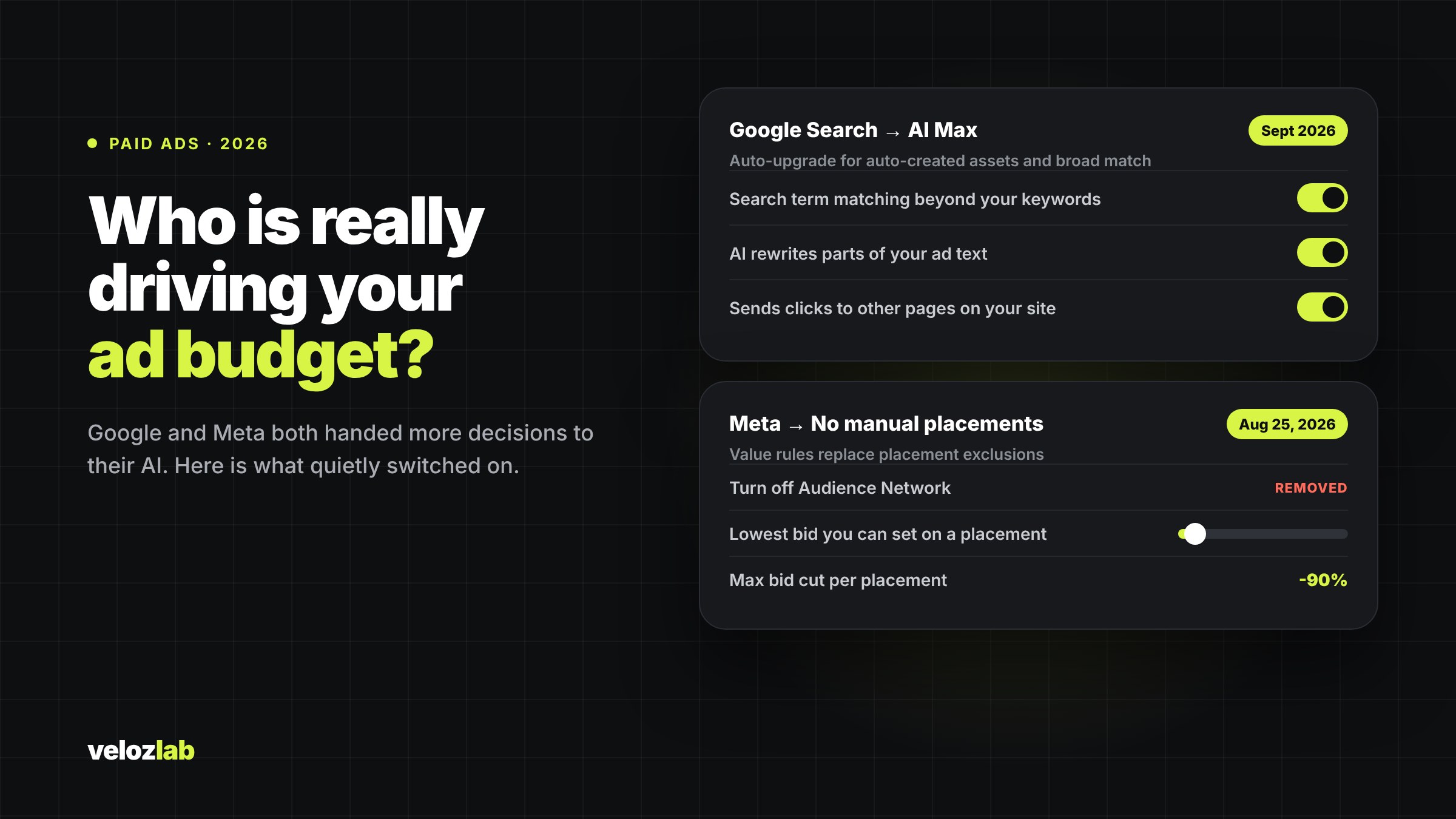
- Google began auto-upgrading many Search campaigns to AI Max in September 2026, which can widen where and how your ads show.
- Meta removed manual placement controls around August 25, 2026. You can now lower bids on a placement by up to 90%, but not turn it off.
- With less control, clean conversion tracking, strong creative and weekly review matter more than ever.
Change 1: Google is moving Search campaigns to AI Max
AI Max is Google's new layer of automation for Search ads. Instead of showing your ads only for the keywords you chose, it uses AI to find other searches it thinks are relevant, rewrites parts of your ad text and can send people to different pages of your website.
Starting in September 2026, Google began automatically upgrading Search campaigns that use automatically created assets or campaign-level broad match. Campaigns using Dynamic Search Ads will follow later, with Google now pointing to February 2027 for that group.
Google says advertisers who use the full AI Max feature set see, on average, 7% more conversions at a similar cost per conversion. That may well be true for big accounts with lots of data, but for a local business with a small budget there is a real risk: your ad may start showing for searches that are loosely related to what you do, in places you do not serve, and on pages you never meant to promote.
What to check this week
- Open Google Ads and look for AI Max settings on your Search campaigns.
- Review your search terms report and look for searches that have nothing to do with your services.
- Make sure your location settings only target the areas you actually serve.
- Use URL controls so Google does not send people to your blog or careers page instead of your service pages.
- Add negative keywords for anything that is wasting clicks.
Change 2: Meta removed manual placement controls
On Facebook and Instagram, you used to be able to choose where your ads appeared. Many local businesses turned off placements like Audience Network or certain Messenger and Explore surfaces, because those spots tend to bring cheap clicks that rarely turn into customers.
Around August 25, 2026, advertisers started seeing that manual placement controls had disappeared from their ad sets. In their place, Meta now offers "value rules," which let you lower your bids on a placement by up to 90%, but never turn it off completely. Meta's argument is that campaigns using Advantage+ placements get an average cost per action that is 11.7% lower than campaigns with manual settings.
This change did not come out of nowhere. Meta has been removing controls step by step since 2025, and this is the latest part of that shift.
What to check this week
- Look at your results broken down by placement in Ads Manager and see where your budget is actually going.
- Use value rules to reduce bids on placements that do not bring real leads.
- Make sure your creative works in every format, from Reels to Stories to Feed, since your ad can now appear almost anywhere.
- Judge your campaigns on leads and booked jobs, not on clicks or cost per click.
The bigger picture: you are training the machine now
Both changes point in the same direction. The platforms want their AI to decide where and how your ads run, and the business owner's job is shifting from choosing every setting to feeding the system good information.
In practice, that means three things matter more than ever:
1. Clean conversion tracking
If Google and Meta only see clicks, they will optimize for clicks. If they see real calls, form submissions and booked jobs, they will look for more people like your actual customers. Our guide on tracking every lead shows how to set this up.
2. Strong creative
With fewer targeting controls, your images, videos and copy are what decides who stops and who scrolls.
3. Someone watching the numbers
Automation works best with a human checking the reports every week and correcting course when something drifts. That weekly check is a core part of how we run paid ads for local businesses.
Need a second pair of eyes on your ads?
If you are not sure whether these changes are already affecting your campaigns, our free 2-Minute Marketing Checkup is a good starting point. It shows where your marketing is leaking leads, from tracking to ads to your website.
Sources: Google Ads & Commerce Blog, "Dynamic Search Ads are upgrading to AI Max" (2026); PPC Land, "Meta removes ad placement controls as bid cuts get capped at 90%" (2026).
The Quietest Hurricane Season in 112 Years: What It Means for South Florida Contractors
If you live in South Florida, you have probably noticed that this hurricane season feels different. There were no cone maps on the news every night and no lines for plywood at the hardware store. For once, September came and went without anyone in Palm Beach, Broward or Miami-Dade having to think about evacuation zones.
The numbers confirm what everyone is feeling, and for contractors they also carry a warning.
Key takeaways
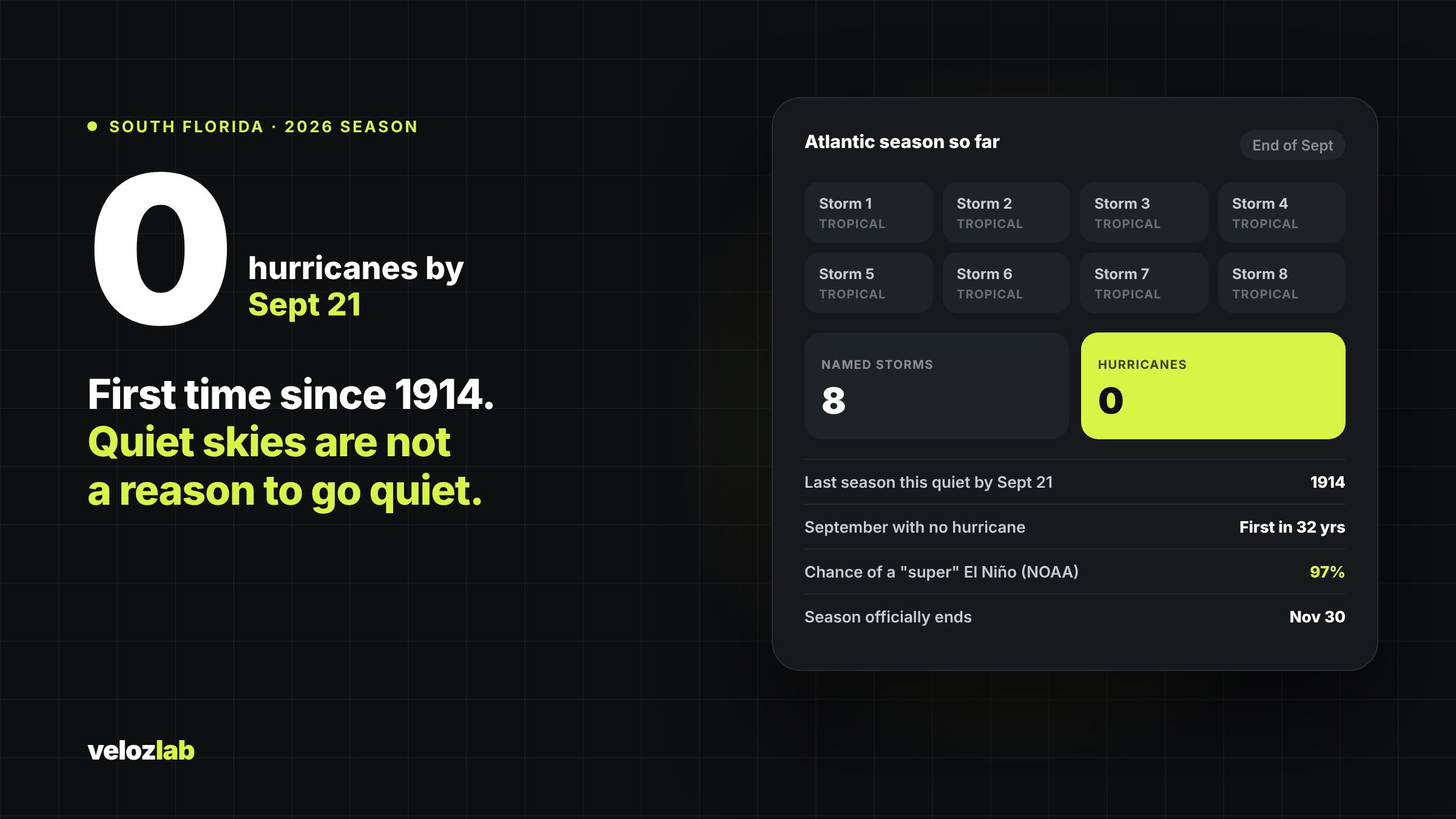
- 2026 reached September 21 without a single Atlantic hurricane, something not seen since 1914.
- When storms stay off the news, homeowners postpone roof and window work, but the demand does not disappear.
- Calm months are the cheapest time to build reviews, rankings and visibility, so you are the obvious call when demand returns.
A season that broke a century-old record
On September 21, 2026, the Atlantic reached that date without producing a single hurricane, which had not happened since 1914. By the end of September, eight named storms had formed and not one of them had become a hurricane, making it the first September without a hurricane in 32 years.
Forecasters point to a strong El Niño as the main reason. El Niño brings stronger upper level winds across the Caribbean and the Atlantic, and those winds tear storms apart before they can organize. NOAA now gives a 97% chance that this El Niño will reach "super" strength between October and December.
1914
was the last time the Atlantic reached September 21 without a hurricane.
WCAX, citing NOAA and National Hurricane Center data
The season still runs until November 30, and forecasters keep reminding everyone that late season storms can form in the western Caribbean or the Gulf. Even so, 2026 is shaping up to be one of the calmest years on record.
Good news for homeowners, tricky news for contractors
For families, a quiet season is a relief. For roofers, impact window companies, generator installers and anyone else whose phone rings louder after a storm, it creates a different kind of challenge.
When there is no storm in the news, homeowners stop thinking about their roof. The inspection they meant to schedule gets pushed to next year, and the impact window quote sits in their inbox. In the meantime, many contractors look at a slower month and decide to cut the marketing budget until "things pick up."
That is usually the most expensive decision of the year.
Why a quiet year is the best time to get louder
Demand is delayed, not gone
Roofs keep aging, and many Florida insurers still look closely at roof age when it is time to renew a policy. Homeowners who postpone this year will need the work later, and they will call whoever they remember.
Attention is cheaper
When half your competitors pause their ads and stop posting, the ones who keep showing up get more visibility for the same money.
Trust takes time to build
Reviews, Google rankings and a strong social presence are not built in the week after a storm. They are built in calm months like these, so that when demand comes back, your name is already the obvious choice.
Storms are not the only trigger
Home sales, insurance renewals, inspections for a refinance and simple wear and tear keep generating work every month of the year.
Five things to do while the skies are clear
- Talk to homeowners about prevention, not panic. A quiet season is the perfect moment for content like "Is your roof ready for next year?" or "What insurers check on a Florida roof." It is helpful, and it does not rely on fear.
- Collect reviews from every recent job. Fresh reviews are what homeowners check first, and slow months give your crew more time to ask properly. Here is a simple review system any crew can run.
- Fix your Google Business Profile. Update photos, services and service areas, and post at least once a week so Google sees an active business.
- Build the pages you never had time for. A page for each city you serve and each main service will keep working for you when the next busy season arrives, and it is also what AI tools look for when they recommend a contractor.
- Keep a small, steady ad budget. Instead of turning everything off, focus your spending on high intent searches like "roof inspection near me" and on the cities where your best jobs come from.
Calm skies are the time to prepare
South Florida will not stay this quiet forever. Weather patterns change, and El Niño years are often followed by very different seasons. The contractors who use this calm to build their reputation and visibility will be the ones answering the phone when homeowners start calling again.
Is your marketing ready for that moment?
Our free 2-Minute Marketing Checkup shows you where you stand on Google, reviews and your website, and what to fix first.
Sources: WCAX (Sept. 21, 2026), NBC 6 South Florida (Sept. 2026), FOX 5 New York (Oct. 1, 2026), citing NOAA and National Hurricane Center data.
Which Calls Came From Google? Why Contractors Need to Track Every Lead
Ask most contractors where their last ten jobs came from and you will usually hear something like "mostly referrals, some Google, a few from the ads." It sounds reasonable, but when we look closer, it is almost always a guess. And when marketing decisions are based on a guess, the money tends to go to the wrong place.
Key takeaways
- If you cannot connect a booked job to where it came from, your marketing budget is a guess.
- One phone number, an unchecked inbox and "how did you hear about us?" are the usual leaks.
- Tracking numbers, one place for every form, real conversion tracking and a monthly check on closed jobs fix most of it.
The question that decides your marketing budget
Every month you spend money in a few places, whether it is Google Ads, Facebook, a website, a lead platform or the truck wrap. At some point you have to decide what to keep, what to cut and where to put more. If you cannot connect a booked job to the place it came from, that decision becomes a matter of feeling.
In trades like roofing, a single lead from paid ads can easily cost around $250. At that price, sending money to the wrong channel for three or four months adds up fast, while the channel that actually works never gets the budget it deserves.
~$250
is what a single paid lead can cost in trades like roofing. Every untracked one is money you cannot learn from.
Why most contractors are flying blind
The problem is rarely laziness. It usually comes down to a few common gaps:
One phone number for everything
When your website, Google profile, ads and truck all show the same number, every call looks the same.
Forms that go to an inbox nobody checks
A lead from the website lands in an email folder, gets answered late or not at all, and never gets counted.
"How did you hear about us?" is not enough
Customers forget, mix things up or just say "Google" because they googled your name after seeing your sign.
No link between a lead and a sale
Even when you know where a call came from, you may not know if it turned into a $500 repair or a $30,000 replacement.
What good tracking looks like
You do not need an enterprise system. You need four simple pieces working together.
- Separate tracking numbers. A different number for your website, your Google Business Profile and each ad campaign. They all ring your office, but now you can see which one rang.
- Every form goes to one place. Website forms, Facebook lead forms and quote requests should land in a single sheet or CRM, with an instant alert to your phone so nobody waits.
- Analytics that count real actions. Google Analytics and your ad platforms should be set up to record calls, form submissions and booked appointments, not just page views.
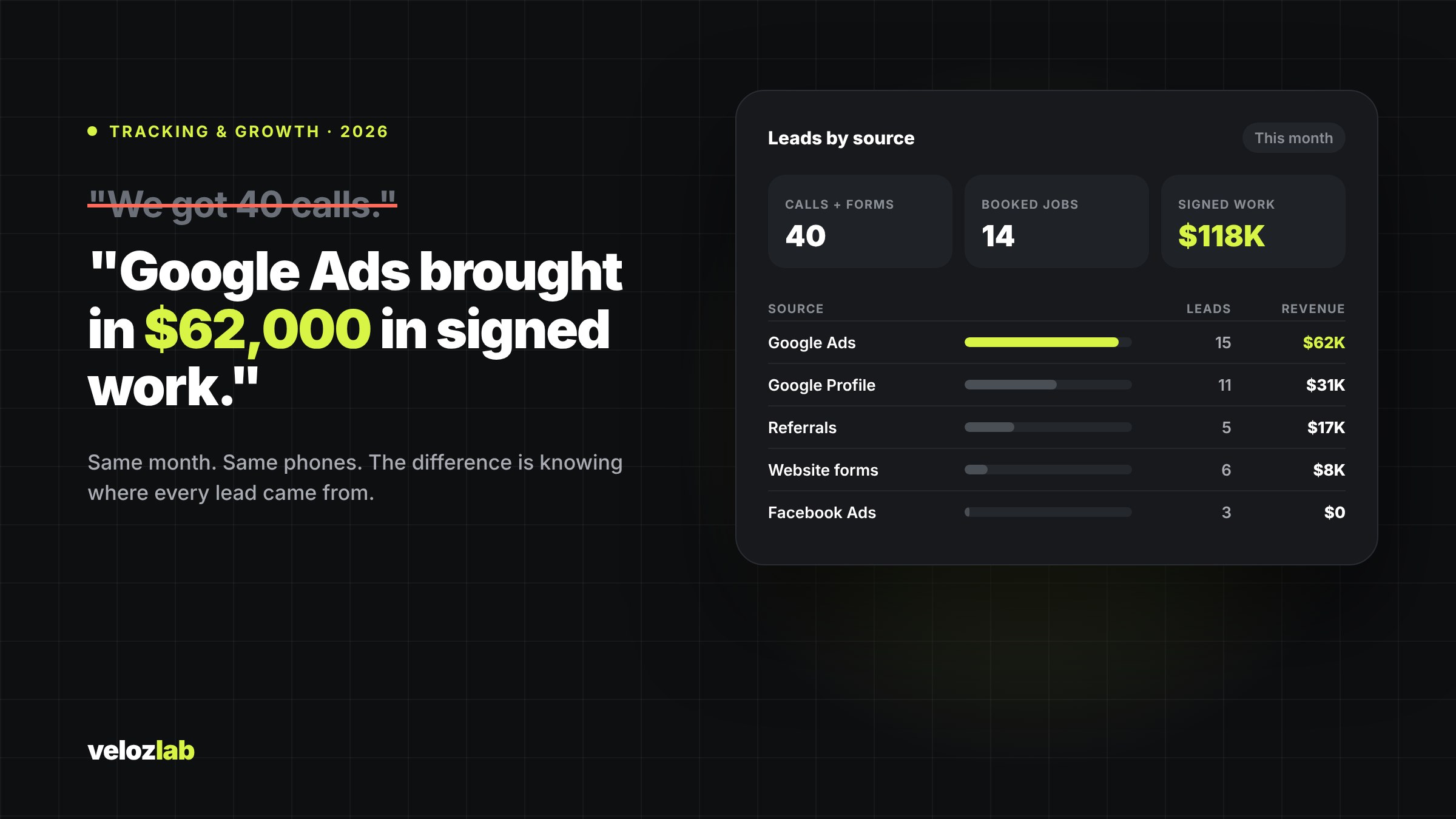
- Close the loop. Once a month, mark which leads became jobs and how much they were worth. This is the step that turns "we got 40 calls" into "Google Ads brought in $62,000 in signed work."
What changes when you can see the numbers
When tracking is in place, the conversation about marketing changes completely. Instead of "should we try TikTok?" you can ask "which channel gives us the cheapest booked job?" You can raise the budget on what works with confidence, cut what does not without regret, and see problems early, like a week when calls are coming in but nobody is booking.
It also keeps your agency honest, including us. When everything is in your name and every lead is counted, results are not a matter of opinion. That is the idea behind our intelligence and growth work.
Start with a quick look
Our free 2-Minute Marketing Checkup shows you where your marketing is leaking leads, from tracking to your Google profile and website. It is a fast way to see what to fix before you spend another dollar.

Homeowners Are Asking ChatGPT for a Contractor. Will It Recommend You?
A few years ago, a homeowner with a leaking roof would open Google, scroll through the results and call two or three companies. Today, more and more of them are typing the whole problem into ChatGPT and asking it who to call, and that changes who gets the job.
Key takeaways
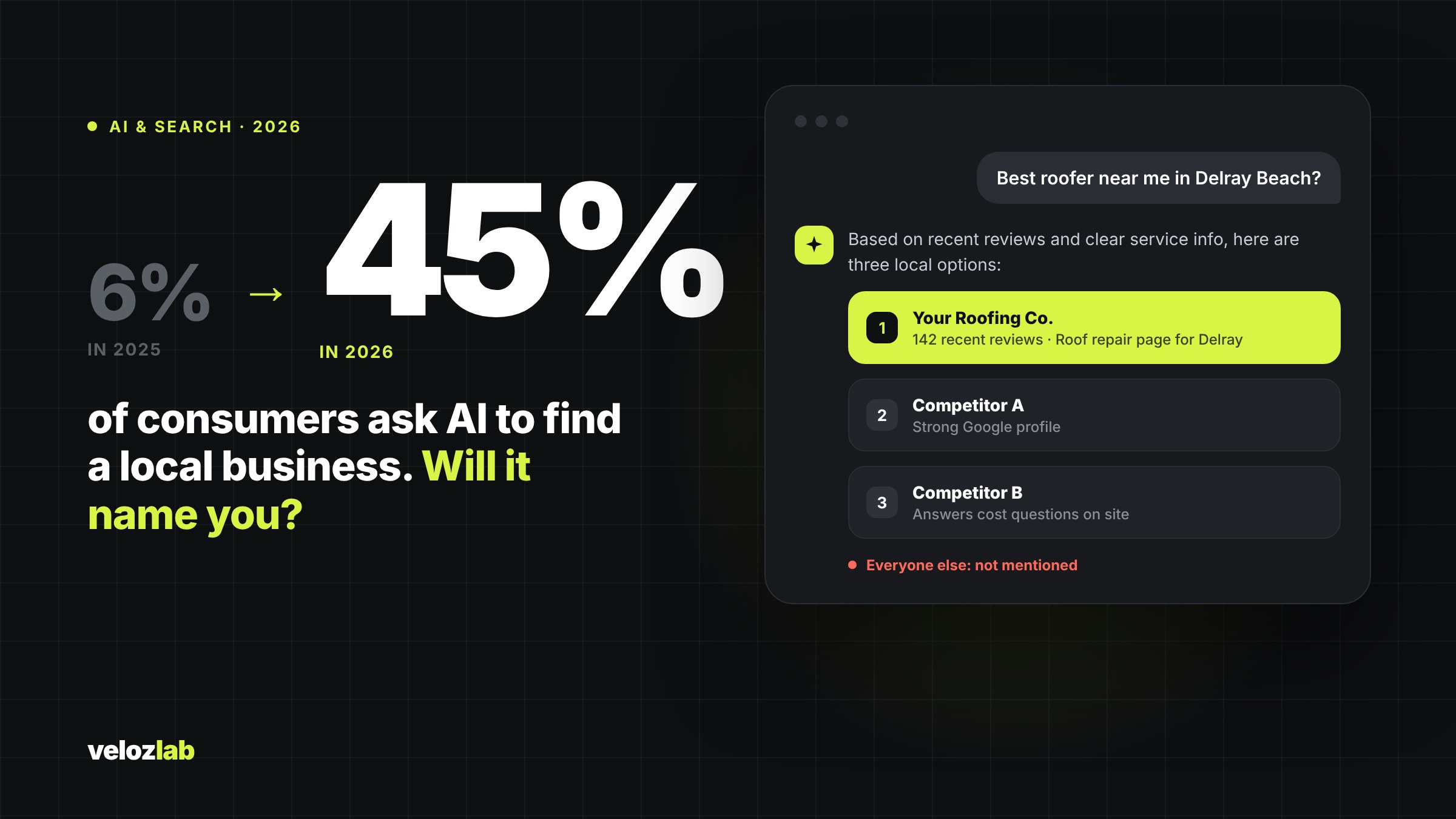
- 45% of US consumers now ask AI tools to recommend local businesses, up from 6% in 2025.
- AI usually names two or three companies, so if you are not one of them the homeowner may never find you.
- A clear website, a complete Google profile, fresh reviews and consistent listings are what AI uses to decide.
The shift happened faster than anyone expected
BrightLocal published a study in March 2026 with a number that surprised a lot of people in our industry. 45% of US consumers now use AI tools to get recommendations for local businesses, up from just 6% in 2025. That makes AI the third most used way to find a local business, behind Google and Facebook and ahead of Yelp.
6% → 45%
of US consumers using AI to find local businesses, from 2025 to 2026.
BrightLocal, March 2026
Trust is following the same path. Among people who use AI this way, 63% say they trust the recommendations they get, and adults between 30 and 44, the age group buying and fixing homes, lead adoption at 64%.
AI does not show ten results. It names a few.
On a normal Google search, being in position seven still gets you some calls. With AI, the answer usually lists two or three businesses and explains why. If you are not one of them, the homeowner may never know you exist.
Google is moving the same way. Studies tracking AI Overviews in 2026 report that when an AI summary appears, people click on regular results much less, but pages cited inside the summary get more than twice the clicks of pages that are not cited. Being the source the AI quotes is becoming more valuable than simply ranking.
How AI decides who to recommend
These tools do not have a secret list of favorite contractors. They put together an answer from what they can find and verify about your business online, which usually includes:
Your Google Business Profile
Categories, services, service areas, photos, hours and, above all, recent reviews.
Your website
Clear pages that say what you do, where you do it and for whom. A page called "Roof Repair in Delray Beach" is much easier for AI to understand than a homepage that says "Quality you can trust."
What others say about you
Reviews on Google, Yelp, Facebook and the BBB, plus mentions in local news, directories and associations.
Consistency
The same name, address, phone and services everywhere. When your information conflicts across sites, AI has less reason to trust it.
Five things you can do this month
- Ask ChatGPT about yourself. Type "Who is the best [your trade] in [your city]?" and see who comes up. Then ask directly about your company and read what it says. This is the fastest way to learn how AI sees you today.
- Build one page per service and per city. If you do roof repair, roof replacement and inspections in Boca Raton and Delray Beach, each of those deserves clear content that answers the questions homeowners actually ask.
- Answer real questions on your site. "How much does a roof replacement cost in Palm Beach County?" or "Does insurance cover storm damage?" are exactly the questions people now ask AI. A plain, honest answer on your site gives AI something to quote.
- Keep your reviews fresh and detailed. Reviews that mention the service and the city help both people and AI connect your name to the right searches. We covered this in detail in why your Google reviews might be costing you jobs.
- Fix your listings. Check that your name, phone and address match on Google, Yelp, Facebook, Apple Maps, Bing and the BBB.
The contractors who move first will be the ones AI remembers
AI search is still new, which means most of your competitors have not done anything about it yet. The ones who build a clear, consistent and well reviewed presence now are the ones these tools will keep recommending as they grow. That is exactly what our local visibility work is built around.
Want to know how visible you are today?
Our free 2-Minute Marketing Checkup shows you where you stand on Google and what is missing for AI to find you.
Sources: BrightLocal, "Half of consumers are asking AI for business recommendations" (March 2026); AI Overviews click data as compiled by Cognizo (2026).

Why Your Google Reviews Might Be Costing You Jobs (Even at 4.8 Stars)
Most contractors we talk to feel good about their reviews. The rating is high, the old customers were happy, and the profile looks fine at a glance. The problem is that homeowners in 2026 are not looking at a glance anymore, and what they check first is often not the stars.
Key takeaways
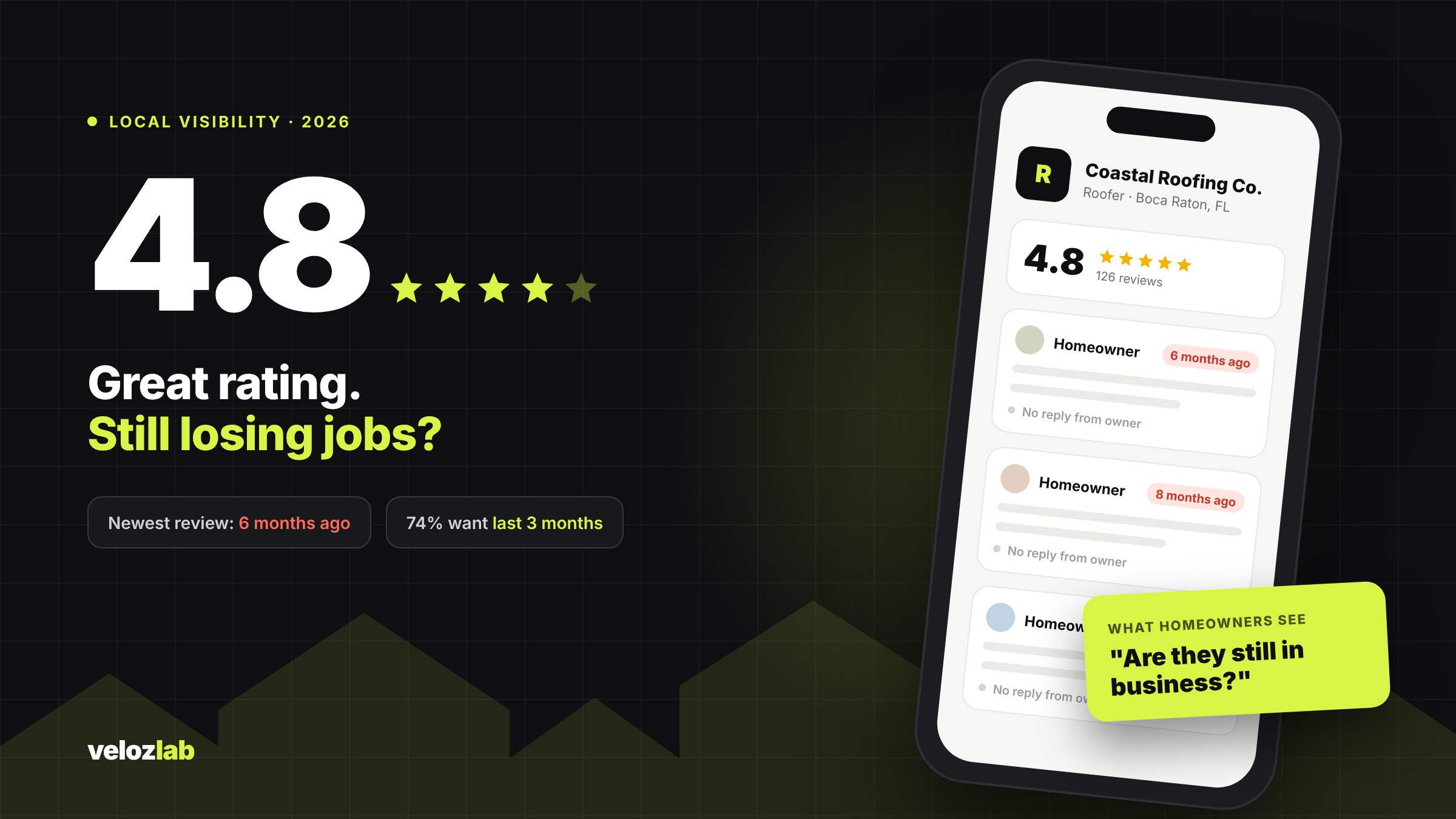
- 74% of homeowners look for reviews from the last three months, so a stale profile hurts even at 4.8 stars.
- 80% are more likely to hire a business that replies to every review, as long as the reply sounds human.
- A simple weekly habit of asking, replying and tracking keeps your reviews working for you.
Homeowners now check the date before the rating
BrightLocal's Local Consumer Review Survey 2026, which polled 1,002 US adults in February, found that 74% of consumers look for reviews written in the last three months, and almost a third want to see reviews from the last two weeks. So when a homeowner in Boca Raton opens your profile and sees that your newest review is from March, a 4.8 rating starts to feel like old news.
74%
of consumers look for reviews written in the last three months.
BrightLocal, Local Consumer Review Survey 2026
The same survey shows that the bar keeps going up. 31% of consumers will only use a business rated 4.5 stars or higher, which is almost double the 17% from the year before, and 41% now say they always read reviews before choosing a business.
Your replies are part of your reputation
Reviews are no longer a one way street. According to the same BrightLocal data, 80% of consumers are more likely to use a business that replies to all of its reviews, while half of them are turned off by generic, copy and paste responses.
This is good news for contractors, because a thoughtful reply is something you control. A response that mentions the job, the neighborhood and the person who did the work shows the next homeowner that real people stand behind the company.
Three signs your reviews are quietly working against you
1. Your newest review is more than 30 days old
Even with a great rating, a long silence makes people wonder if you are still busy or still in business.
2. Half of your reviews have no reply
A homeowner reading a three star review with no answer will assume the worst, even if the issue was solved months ago.
3. Your replies all sound the same
"Thank you for your business!" pasted under every review tells people nobody is really reading.
A simple system any crew can run
You do not need a big tool to fix this. You need a habit that runs every week, whether the office is busy or not.
- Ask at the right moment. The best time to ask for a review is when the job is finished and the customer is still happy, usually on the last day on site. Send a text with your direct Google review link that same afternoon, because a request sent two weeks later rarely gets done.
- Make it easy. One link, one short message and the name of the crew lead who did the work. People are more likely to write something specific when you remind them who helped them.
- Reply within 48 hours. Thank the person by name, mention the type of job and the city, and keep it human. For a negative review, stay calm, own what you can and move the conversation to the phone.
- Track it. Write down how many reviews you get each month and how fast you reply. If the number drops, you will see it before your customers do.
Why this matters even more now
Reviews are not only read by people. When homeowners ask ChatGPT or Google's AI Mode for "the best roofer near me," those tools pull from review platforms and business profiles to decide who to recommend. A steady flow of recent, detailed reviews gives them more to work with, which means your profile helps you in places you cannot even see. That is a big part of how we approach local visibility for South Florida contractors.
Not sure where your reviews stand?
Our free 2-Minute Marketing Checkup looks at your Google presence, your reviews and your website, and shows you where you are losing calls. It takes less time than a coffee break, and you get a clear picture of what to fix first.
Source: BrightLocal, Local Consumer Review Survey 2026.