
Ask most contractors where their last ten jobs came from and you will usually hear something like “mostly referrals, some Google, a few from the ads.” It sounds reasonable, but when we look closer, it is almost always a guess. And when marketing decisions are based on a guess, the money tends to go to the wrong place.
Key takeaways
- If you cannot connect a booked job to where it came from, your marketing budget is a guess.
- One phone number, an unchecked inbox and “how did you hear about us?” are the usual leaks.
- Tracking numbers, one place for every form, real conversion tracking and a monthly check on closed jobs fix most of it.
The question that decides your marketing budget
Every month you spend money in a few places, whether it is Google Ads, Facebook, a website, a lead platform or the truck wrap. At some point you have to decide what to keep, what to cut and where to put more. If you cannot connect a booked job to the place it came from, that decision becomes a matter of feeling.
In trades like roofing, a single lead from paid ads can easily cost around $250. At that price, sending money to the wrong channel for three or four months adds up fast, while the channel that actually works never gets the budget it deserves.
~$250
is what a single paid lead can cost in trades like roofing. Every untracked one is money you cannot learn from.
Why most contractors are flying blind
The problem is rarely laziness. It usually comes down to a few common gaps:
One phone number for everything
When your website, Google profile, ads and truck all show the same number, every call looks the same.
Forms that go to an inbox nobody checks
A lead from the website lands in an email folder, gets answered late or not at all, and never gets counted.
“How did you hear about us?” is not enough
Customers forget, mix things up or just say “Google” because they googled your name after seeing your sign.
No link between a lead and a sale
Even when you know where a call came from, you may not know if it turned into a $500 repair or a $30,000 replacement.
What good tracking looks like
You do not need an enterprise system. You need four simple pieces working together.
- Separate tracking numbers. A different number for your website, your Google Business Profile and each ad campaign. They all ring your office, but now you can see which one rang.
- Every form goes to one place. Website forms, Facebook lead forms and quote requests should land in a single sheet or CRM, with an instant alert to your phone so nobody waits.
- Analytics that count real actions. Google Analytics and your ad platforms should be set up to record calls, form submissions and booked appointments, not just page views.
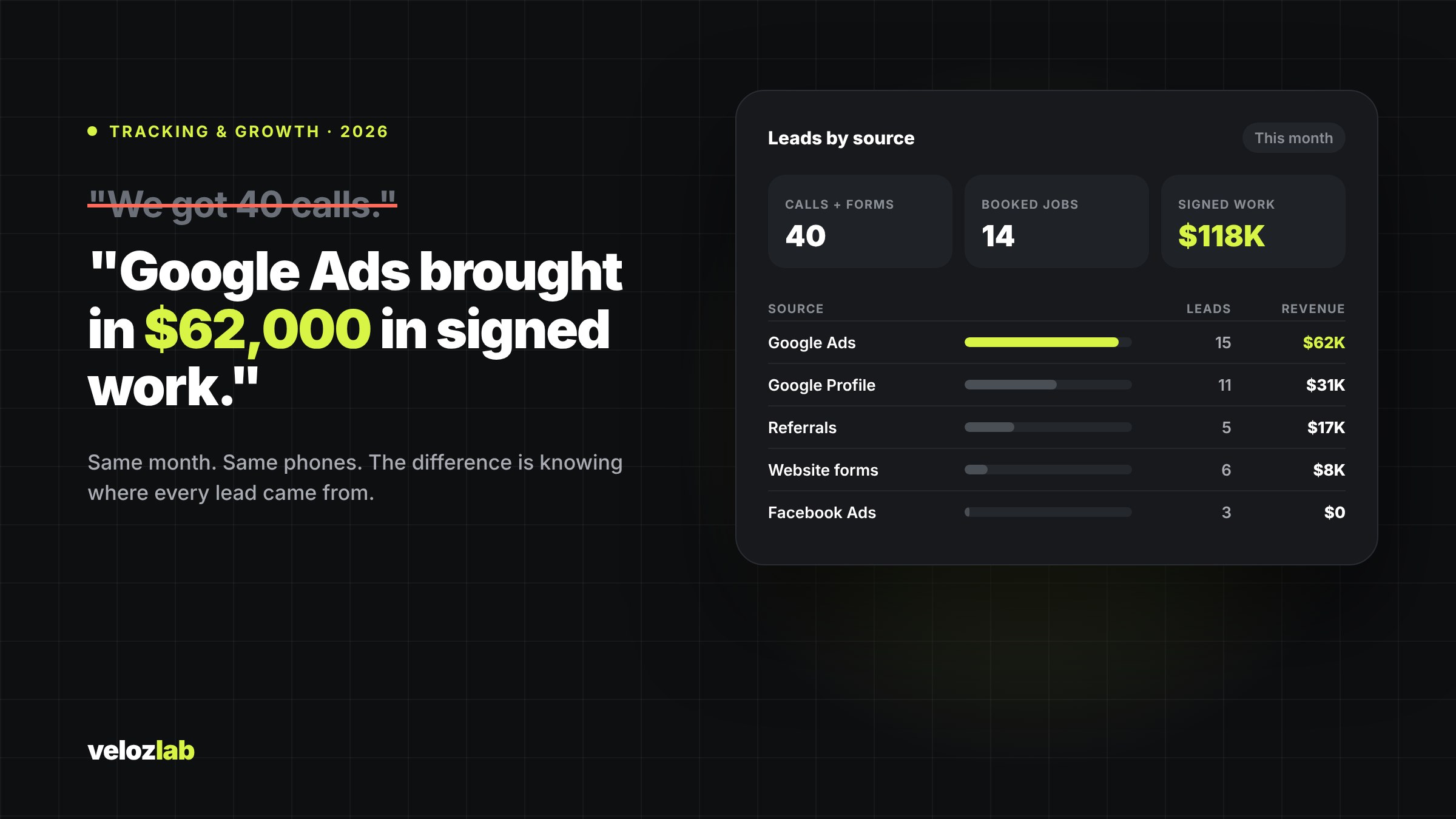
- Close the loop. Once a month, mark which leads became jobs and how much they were worth. This is the step that turns “we got 40 calls” into “Google Ads brought in $62,000 in signed work.”
What changes when you can see the numbers
When tracking is in place, the conversation about marketing changes completely. Instead of “should we try TikTok?” you can ask “which channel gives us the cheapest booked job?” You can raise the budget on what works with confidence, cut what does not without regret, and see problems early, like a week when calls are coming in but nobody is booking.
It also keeps your agency honest, including us. When everything is in your name and every lead is counted, results are not a matter of opinion. That is the idea behind our intelligence and growth work.
Start with a quick look
Our free 2-Minute Marketing Checkup shows you where your marketing is leaking leads, from tracking to your Google profile and website. It is a fast way to see what to fix before you spend another dollar.