

Cheap Marketing for Electricians Can Get You Fined, Not Hired
Low price does not buy correct marketing, and for electrical contractors this is not a slogan, it is a legal and platform reality. A cheap quote can leave you running ads that violate state law, disqualify you from Google's best local program, and still cost you more per lead than doing it right. This piece is about why the cheapest option in a regulated trade is often the most expensive one you will ever buy.
Key takeaways
- Florida law requires your contractor registration or certification number on every ad, bid, and proposal, and skipping it can trigger fines up to 10,000 dollars.
- Google treats electricians as high risk and will disqualify your whole business from Local Services Ads over one failed background check, no refund for the cheap setup that caused it.
- Electrician leads cost more than any other home services trade on Google, so a discount agency that ignores the compliant, lower cost channel is not saving you money, it is burning it.
The quote that skips the license number is not a bargain
Under Florida Statute 489.119, every offer of services, proposal, bid, contract, and advertisement you run, in any medium, must show your contractor registration or certification number. That means your Google Business Profile, your website footer, your Facebook ad, your truck wrap, and your printed flyer all need it. The licensing board can issue a notice of noncompliance first, then move to fines or citations if nothing changes.
This is not a minor paperwork detail. Florida's Electrical Contractors' Licensing Board oversees roughly 18,000 licensees under Chapter 489, Part II, and the state actively audits advertising for compliance. A marketing vendor who builds your ad campaigns, your website, or your Google listing without checking this requirement is not giving you a discount. They are handing you a liability with your name on it.
The fines are real and they stack
Florida does not treat advertising violations as a slap on the wrist. If you are found engaging in or advertising unlicensed contracting work, the Department of Business and Professional Regulation can impose an administrative fine of up to 10,000 dollars, plus investigative and legal costs on top of that. Even short of that, DBPR can issue a citation with a fine of up to 2,500 dollars simply for offering or advertising unlicensed activity, separate from any criminal exposure.
A cheap marketing shop that builds generic ad templates across trades, without understanding the specific disclosure rules for electrical contracting, is not saving you money on the front end. They are setting you up to pay the state later, on top of what you already paid them. We wrote about this exact trap in why a cheap marketing quote costs more later, and electrical contracting is one of the clearest proofs of that pattern.
Google does not grade on a curve for electricians
Even if your paperwork is clean, the platform itself can shut you out. Google's Local Services Ads program runs background checks on the business, the owner, and every field worker, and verifies licenses against state databases. Electricians are flagged as a high risk category facing Advanced Verification, which can include a video interview before you are approved to run a single ad.
Here is the part most owners do not know until it happens to them. One failed background check, for the business or for a single technician, disqualifies the entire business from the program. A denial means a 30 day wait to reapply, and a second denial triggers a 180 day lockout. If a low cost vendor rushes your setup, skips proper documentation, or does not prepare your team for verification, you are not looking at a slow month. You are looking at six months without access to one of the strongest local channels available to a contractor.
The real price of a lead when you cut corners
Electrical work is already the most expensive trade to advertise on Google. In 2026, electricians face an average cost per click of 12.18 dollars, higher than HVAC at 9.50, plumbing at 11.81, and roofing at 7.85. That gap compounds fast once you look at full lead cost.
- Traditional Google Search Ads cost electricians an average of 93.69 dollars per lead in 2026, the highest of any home services trade.
- Local Services Ads, the program with strict verification, deliver electrician leads at roughly 39 dollars each, about a 58 percent reduction.
- Median monthly lead costs have climbed from about 117 dollars in 2024 to 161 dollars through mid 2026, with monthly medians ranging from 124 to 190 dollars.
Put that together and the math is simple. A vendor who cannot get you qualified for Local Services Ads, because they rushed the compliance work, is quietly pushing you toward the channel that costs more than double per lead. The cheap setup fee you paid up front shows up later as a much higher cost per job booked. If you are not tracking which channel actually produces the call, you will never see this gap. That is exactly why we built out the reasoning in why contractors need to track every lead back to its source.
Why the budget was probably too small to begin with
Part of why owners reach for the cheapest quote is that most small businesses are already underfunding marketing. The Small Business Administration has long recommended that companies under 5 million dollars in revenue spend 7 to 8 percent of revenue on marketing. Yet The CMO Survey's January 2026 data found small businesses actually spend a median of just 5 percent. You are already starting from a smaller pool than the guidance recommends, so stretching it further with a bargain vendor only shrinks your margin for error on compliance and platform risk.
The honest counterargument
The strongest pushback is real and worth naming directly. Many electrical contractors are running tight margins, dealing with slow payment cycles, and a 2,000 dollar monthly marketing bill feels like a risk they cannot absorb compared to a 500 dollar option. That concern is legitimate, not naive.
But the comparison is not between a 500 dollar vendor and a 2,000 dollar vendor doing the same job cheaper or pricier. It is between a vendor who understands 489.119 disclosure rules, prepares you for Local Services Ads verification, and tracks your leads by source, versus one who does not. The first protects you from a 2,500 to 10,000 dollar fine and gets you into the 39 dollar lead channel. The second leaves you exposed to both the fine and the 93.69 dollar lead channel. The price difference between the two vendors is often smaller than the cost of the mistakes the cheap one makes.
What to check before you sign anything
- Ask directly if your license or registration number will appear on every ad, listing, and proposal they build.
- Ask if they have gotten other electrical or home services clients approved for Local Services Ads, and how they handle the background check process.
- Ask how leads are tracked back to the exact channel and campaign that produced them, not just a monthly total.
- Ask what happens if an ad account gets flagged or disqualified, and who is responsible for fixing it.
If a vendor cannot answer these clearly, the low price is not a discount. It is a deferred cost with your name on the fine.
Make sure your ads are compliant and your leads are cheap, not just your quote
Call VelozLab for a quick conversation about where your electrical contracting marketing stands on compliance, Local Services Ads eligibility, and real cost per lead.


Why a Cheap Marketing Quote Costs More Later
A cheap marketing quote is not a lower price for marketing. It is a lower price for the appearance of marketing, and the real bill arrives later in wasted ad spend, invisible local listings, and leads that never turn into jobs. At VelozLab we tell owners this directly: price what you buy on correct execution and tracked return, never on the number at the bottom of the proposal.
Key takeaways
- A low invoice often hides broken execution, and the hidden cost shows up in invalid clicks, bad targeting, and listings that quietly disappear from local search.
- Electrical contractors and other home service businesses can pay more than double per lead when campaigns are built cheaply instead of correctly, even with the same budget.
- Spending nothing is not a safer alternative to spending wrong. The fix is pricing marketing on tracked results, not on who quoted the smallest number.
The Real Price Tag on a Cheap Marketing Quote
Owners compare marketing quotes the way they compare a quote for a new roof or a new sign. Lowest number wins. But marketing is not a fixed product. It is a system of targeting, tracking, content, and follow up, and a cheap quote almost always means one or more of those pieces was skipped to hit the price.
The Small Business Administration recommends businesses under 5 million in revenue invest 7 to 8 percent of gross revenue in marketing, assuming healthy net margins. That is not a random number. It reflects what it actually costs to run campaigns correctly, with real tracking and real strategy behind them. A quote priced well under that benchmark is not a discount. It is a signal that something in the system was cut.
Why a Low Bid Behaves Like a Hidden Tax
Across the industry, research cited by MediaFuel shows up to 60 percent of small and mid-size business marketing budgets are wasted on poor targeting, tracking, or alignment, with a separate estimate putting the national waste from ads that never reach the right audience at 37 billion dollars a year. That waste does not show up on the invoice. It shows up three months later when the owner asks why the phone is not ringing.
Ad fraud compounds the problem. An analysis of thousands of Google Ads accounts found an average invalid click rate of 11.4 percent, with roughly 22 percent of global digital ad budgets lost to fraud every year. Industry projections now put total digital ad fraud at over 100 billion dollars globally in 2026, meaning close to one in five ad dollars never reaches a real customer. A cheap setup with no fraud filtering and no call tracking pays that tax in full. A correctly built campaign catches and blocks most of it.
It is no surprise that 73 percent of small business owners in Constant Contact's research say they are not even sure their current marketing is working. When execution is cheap, measurement is usually the first thing to go, because tracking takes real setup time that a discount quote does not budget for.
The Electrical Contractor Case: Same Budget, Different Outcome
Electrical contractors are a clean example because the numbers are well documented. The standard benchmark for the trade is 5 to 10 percent of gross revenue on marketing, where spend sustained below 5 percent signals under-investment and spend above 12 percent usually points to broken unit economics rather than ambition. Price is not the only lever. Execution inside that budget decides everything.
2026 benchmark data across nearly 900 electrical contractors and over 126,000 leads found Local Services Ads generating leads at about 39 dollars each, with a 43.4 percent booking rate and a 1,434 dollar average ticket. Standard Google Search Ads for the same trade ran closer to 93.69 dollars per lead, more than double the cost, driven by targeting and setup quality rather than bid amount. Two contractors can spend the same dollar figure and walk away with results that differ by a factor of two, purely because one campaign was built correctly and the other was built cheaply.
Quality Score makes the gap worse over time. A keyword scoring 1 to 3 can cost up to 400 percent more per click than the same keyword at a baseline score of 5, while a score of 10 earns roughly a 50 percent discount versus average. A rushed, cheap campaign setup tends to produce low Quality Scores from day one, which means the owner keeps paying a penalty on every click for as long as the account runs.
Local visibility carries the same risk outside of paid ads. We have written before about how fragile local listings can be, and how a small inconsistency in a business's name and address can cause real damage, which ties directly into our piece on why strong Google reviews do not always translate into more jobs. A single formatting slip across directories, something as small as a stray comma appearing on one listing but not another, has been documented to cost a law firm 60 percent of its local search traffic because Google treated the two listings as separate, unverified entities. A cheap setup that skips listing audits leaves that exposure in place indefinitely.
The Honest Counterargument: Something Is Better Than Nothing
The strongest pushback to this whole argument is reasonable. A cash-strapped owner in year one cannot write a check for correct, full-scope marketing. Something small, they argue, still beats doing nothing at all.
There is truth in that, but the data shows most owners are not choosing a small, smart version of marketing. They are choosing almost none. 26.1 percent of newly started businesses surveyed in 2026 plan to spend nothing at all on marketing, and another 64.3 percent plan to spend only 1 to 200 dollars a month. That is not a budget decision. It is a decision to stay invisible while competitors with correct setups capture the searches, the ads, and the reviews.
The answer is not to spend everything at once. It is to spend a smaller amount correctly rather than a larger amount carelessly. A tightly targeted, properly tracked 300 dollar campaign will outperform a loosely built 1,000 dollar campaign almost every time, because the waste in the second one erases the extra spend and then some.
What Correct Marketing Actually Costs and Returns
Even large, well-funded companies are tightening budgets right now. Gartner's 2026 CMO Spend Survey of 401 senior marketing leaders found average budgets flat at 7.8 percent of revenue, roughly 18 percent lower than four years earlier. If companies with full marketing departments are being this disciplined, a local contractor or dealer has even less room to fund guesswork.
Correct marketing costs more up front because it includes real audience targeting, conversion tracking on every call and form, listing consistency audits, and content built for the platforms people actually search on. This is also why we wrote about how Google and Meta have quietly taken more control over where ad budgets get spent. When the platforms automate placement decisions, a correctly configured account protects your budget. A cheap, hands-off account hands that control over with no guardrails.
How to Price Marketing on Execution, Not the Invoice
Before signing any marketing quote, ask these questions instead of asking for a lower number:
- Does the proposal include call tracking so you know which leads came from which channel, not just a total lead count
- Is there a plan to audit and fix your business name, address, and phone listings across directories
- Does the media buy include fraud and invalid click filtering, or just raw spend
- Is there a target cost per lead based on your trade's benchmark, not a vague promise of more visibility
- Will you see monthly reporting tied to actual bookings, not just impressions and clicks
If a vendor cannot answer these clearly, the quote is cheap because the execution is thin, and you will pay for that gap later, just in a different column of your books. For a deeper look at why tracking every call matters for trades like electrical work, see our piece on why contractors need to track every lead that comes through Google.
Get a straight read on your marketing spend
If you want to know whether your current budget is buying correct execution or just the appearance of it, call VelozLab for a quick, honest conversation about your numbers.

Google and Meta Just Took More Control of Your Ad Budget. Here Is What Changed
If you run ads on Google or Facebook for your business, the last few weeks brought two changes that could affect where your money goes. Neither one arrived with a big announcement in your inbox, which is exactly why so many business owners have not noticed yet.
Here is what happened, in plain English, and what to check before it costs you.
Key takeaways
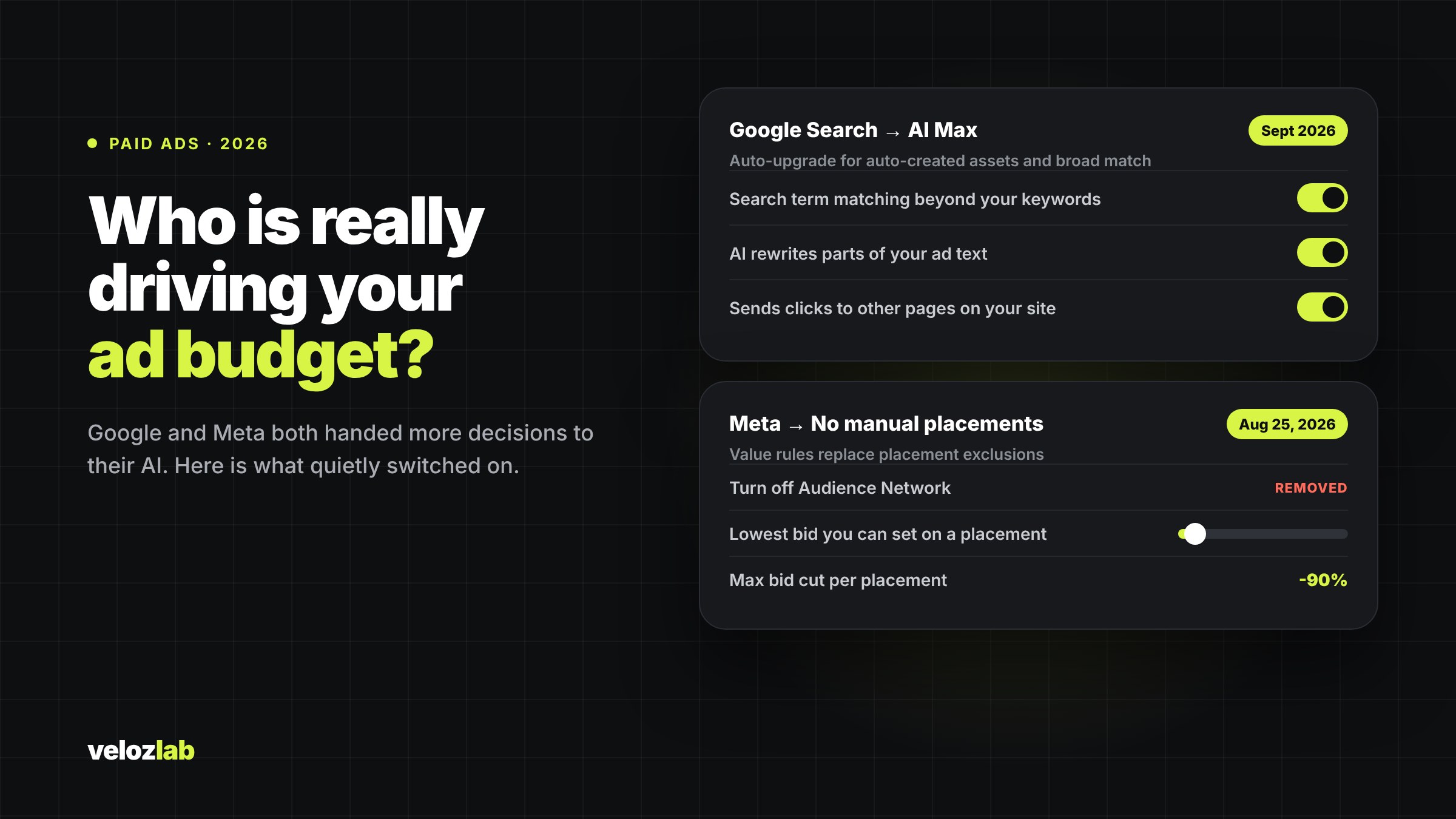
- Google began auto-upgrading many Search campaigns to AI Max in September 2026, which can widen where and how your ads show.
- Meta removed manual placement controls around August 25, 2026. You can now lower bids on a placement by up to 90%, but not turn it off.
- With less control, clean conversion tracking, strong creative and weekly review matter more than ever.
Change 1: Google is moving Search campaigns to AI Max
AI Max is Google's new layer of automation for Search ads. Instead of showing your ads only for the keywords you chose, it uses AI to find other searches it thinks are relevant, rewrites parts of your ad text and can send people to different pages of your website.
Starting in September 2026, Google began automatically upgrading Search campaigns that use automatically created assets or campaign-level broad match. Campaigns using Dynamic Search Ads will follow later, with Google now pointing to February 2027 for that group.
Google says advertisers who use the full AI Max feature set see, on average, 7% more conversions at a similar cost per conversion. That may well be true for big accounts with lots of data, but for a local business with a small budget there is a real risk: your ad may start showing for searches that are loosely related to what you do, in places you do not serve, and on pages you never meant to promote.
What to check this week
- Open Google Ads and look for AI Max settings on your Search campaigns.
- Review your search terms report and look for searches that have nothing to do with your services.
- Make sure your location settings only target the areas you actually serve.
- Use URL controls so Google does not send people to your blog or careers page instead of your service pages.
- Add negative keywords for anything that is wasting clicks.
Change 2: Meta removed manual placement controls
On Facebook and Instagram, you used to be able to choose where your ads appeared. Many local businesses turned off placements like Audience Network or certain Messenger and Explore surfaces, because those spots tend to bring cheap clicks that rarely turn into customers.
Around August 25, 2026, advertisers started seeing that manual placement controls had disappeared from their ad sets. In their place, Meta now offers "value rules," which let you lower your bids on a placement by up to 90%, but never turn it off completely. Meta's argument is that campaigns using Advantage+ placements get an average cost per action that is 11.7% lower than campaigns with manual settings.
This change did not come out of nowhere. Meta has been removing controls step by step since 2025, and this is the latest part of that shift.
What to check this week
- Look at your results broken down by placement in Ads Manager and see where your budget is actually going.
- Use value rules to reduce bids on placements that do not bring real leads.
- Make sure your creative works in every format, from Reels to Stories to Feed, since your ad can now appear almost anywhere.
- Judge your campaigns on leads and booked jobs, not on clicks or cost per click.
The bigger picture: you are training the machine now
Both changes point in the same direction. The platforms want their AI to decide where and how your ads run, and the business owner's job is shifting from choosing every setting to feeding the system good information.
In practice, that means three things matter more than ever:
1. Clean conversion tracking
If Google and Meta only see clicks, they will optimize for clicks. If they see real calls, form submissions and booked jobs, they will look for more people like your actual customers. Our guide on tracking every lead shows how to set this up.
2. Strong creative
With fewer targeting controls, your images, videos and copy are what decides who stops and who scrolls.
3. Someone watching the numbers
Automation works best with a human checking the reports every week and correcting course when something drifts. That weekly check is a core part of how we run paid ads for local businesses.
Need a second pair of eyes on your ads?
If you are not sure whether these changes are already affecting your campaigns, our free 2-Minute Marketing Checkup is a good starting point. It shows where your marketing is leaking leads, from tracking to ads to your website.
Sources: Google Ads & Commerce Blog, "Dynamic Search Ads are upgrading to AI Max" (2026); PPC Land, "Meta removes ad placement controls as bid cuts get capped at 90%" (2026).