
If you run ads on Google or Facebook for your business, the last few weeks brought two changes that could affect where your money goes. Neither one arrived with a big announcement in your inbox, which is exactly why so many business owners have not noticed yet.
Here is what happened, in plain English, and what to check before it costs you.
Key takeaways
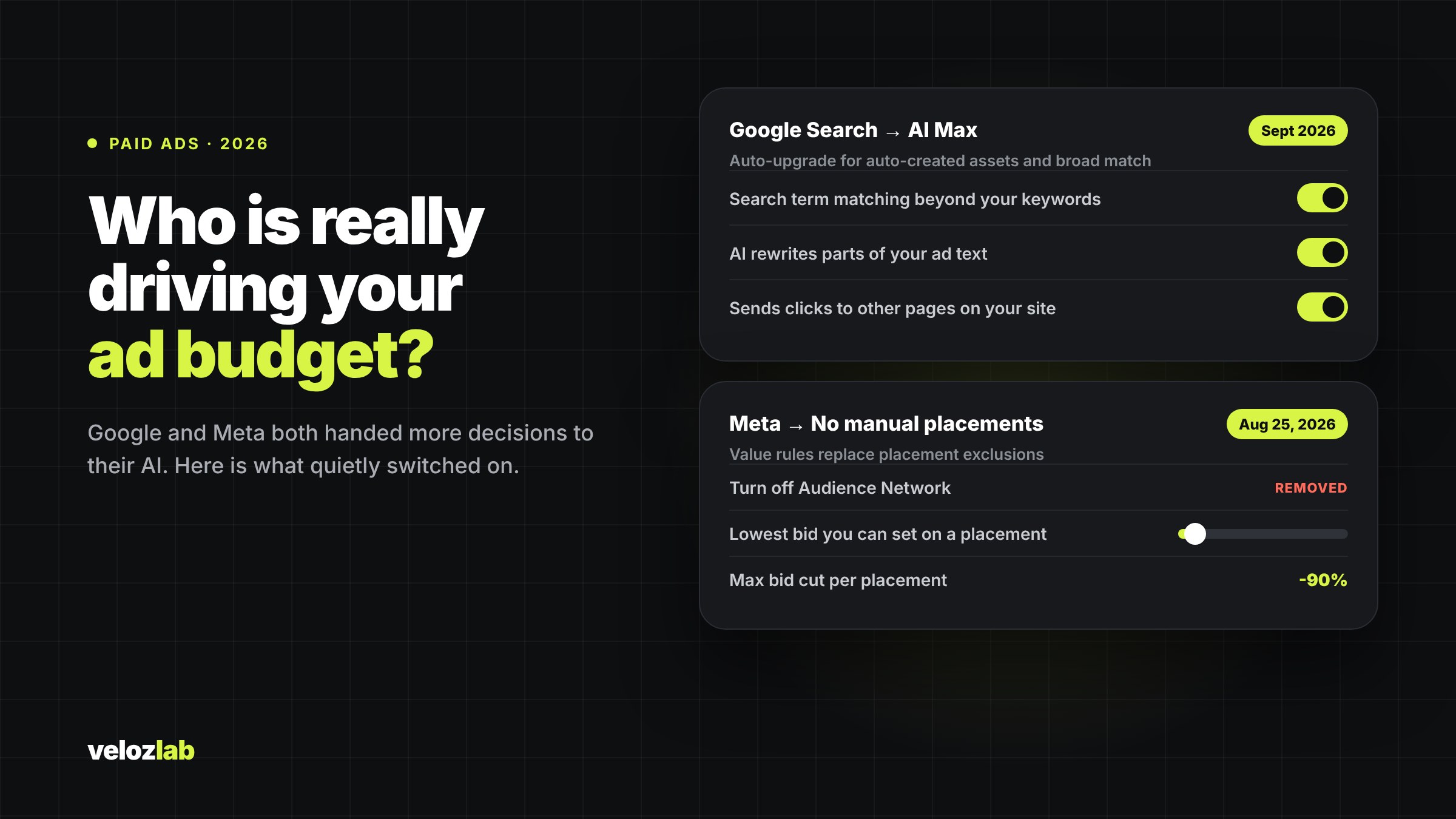
- Google began auto-upgrading many Search campaigns to AI Max in September 2026, which can widen where and how your ads show.
- Meta removed manual placement controls around August 25, 2026. You can now lower bids on a placement by up to 90%, but not turn it off.
- With less control, clean conversion tracking, strong creative and weekly review matter more than ever.
Change 1: Google is moving Search campaigns to AI Max
AI Max is Google’s new layer of automation for Search ads. Instead of showing your ads only for the keywords you chose, it uses AI to find other searches it thinks are relevant, rewrites parts of your ad text and can send people to different pages of your website.
Starting in September 2026, Google began automatically upgrading Search campaigns that use automatically created assets or campaign-level broad match. Campaigns using Dynamic Search Ads will follow later, with Google now pointing to February 2027 for that group.
Google says advertisers who use the full AI Max feature set see, on average, 7% more conversions at a similar cost per conversion. That may well be true for big accounts with lots of data, but for a local business with a small budget there is a real risk: your ad may start showing for searches that are loosely related to what you do, in places you do not serve, and on pages you never meant to promote.
What to check this week
- Open Google Ads and look for AI Max settings on your Search campaigns.
- Review your search terms report and look for searches that have nothing to do with your services.
- Make sure your location settings only target the areas you actually serve.
- Use URL controls so Google does not send people to your blog or careers page instead of your service pages.
- Add negative keywords for anything that is wasting clicks.
Change 2: Meta removed manual placement controls
On Facebook and Instagram, you used to be able to choose where your ads appeared. Many local businesses turned off placements like Audience Network or certain Messenger and Explore surfaces, because those spots tend to bring cheap clicks that rarely turn into customers.
Around August 25, 2026, advertisers started seeing that manual placement controls had disappeared from their ad sets. In their place, Meta now offers “value rules,” which let you lower your bids on a placement by up to 90%, but never turn it off completely. Meta’s argument is that campaigns using Advantage+ placements get an average cost per action that is 11.7% lower than campaigns with manual settings.
This change did not come out of nowhere. Meta has been removing controls step by step since 2025, and this is the latest part of that shift.
What to check this week
- Look at your results broken down by placement in Ads Manager and see where your budget is actually going.
- Use value rules to reduce bids on placements that do not bring real leads.
- Make sure your creative works in every format, from Reels to Stories to Feed, since your ad can now appear almost anywhere.
- Judge your campaigns on leads and booked jobs, not on clicks or cost per click.
The bigger picture: you are training the machine now
Both changes point in the same direction. The platforms want their AI to decide where and how your ads run, and the business owner’s job is shifting from choosing every setting to feeding the system good information.
In practice, that means three things matter more than ever:
1. Clean conversion tracking
If Google and Meta only see clicks, they will optimize for clicks. If they see real calls, form submissions and booked jobs, they will look for more people like your actual customers. Our guide on tracking every lead shows how to set this up.
2. Strong creative
With fewer targeting controls, your images, videos and copy are what decides who stops and who scrolls.
3. Someone watching the numbers
Automation works best with a human checking the reports every week and correcting course when something drifts. That weekly check is a core part of how we run paid ads for local businesses.
Need a second pair of eyes on your ads?
If you are not sure whether these changes are already affecting your campaigns, our free 2-Minute Marketing Checkup is a good starting point. It shows where your marketing is leaking leads, from tracking to ads to your website.
Sources: Google Ads & Commerce Blog, “Dynamic Search Ads are upgrading to AI Max” (2026); PPC Land, “Meta removes ad placement controls as bid cuts get capped at 90%” (2026).